We explore if there could be a sonic equivalent to the curvature of spacetime, and/or how to interpret this in a soniverse (sonic universe) – as an Acoustic Cosmology.
The question may sound poetic; it is. We are treating it as part creative, part research, part engagement programme where we explore sonic universes, soniverses, built from a single fundamental particle and governed by laws borrowed from our real world cosmology, imagined cosmologies and quantum mechanics. Some of those laws are causal (ie. the physics is self-consistent inside the soniverse) and some are aesthetic (ie. personal choices, interpretations and emotional responses).
Framework
The Soniverse builds on some definitions:
- Sonon. One wavelength: the fundamental particle of the soniverse, the equivalent of a photon. A sonon exists in a superposition of musical states and is only rendered musical by being heard. The listener is the observer and hearing can be considered its measurement (there can also be visual representations, but we’ll come back to that).
- Wave-time. Time in the soniverse has (at least) three independent dimensions: the sonon’s own wavelength, instrument time (how long an instrument plays), and performance time (how long a piece lasts). An instrument time can exceed a performance time.
- Temporal gravity. Sonons attract one another at intervals proportional to their relative density. Repetition within a local event horizon clusters them into mass, the soniverse’s equivalent of a rhythmic or melodic phrase, and clusters bend the wave-time around them.
- The epoch. The soniverse has a finite age, equal to or longer than the performance. Its big bang is the spontaneous creation of all sonons that can exist, from which singularities, entropy, redshift and curvature can be built.
A good place to start Gavin’s 2022 piece “Escape into the Multiverse: an Acoustic Cosmology“, Gavin & Andy’s Royal Astronomical Society presentation “Adventures in Acoustic Cosmology” (2017), and Andy Newsam’s soniverse model.
A very brief history of 2,500 years
The soniverse continues ideas that have been evolving for 2,500 years.
Pythagoras (500BCE, Musica Universalis) and Kepler (1619, Harmonice_Mundi) proposed a potential structural harmony between celestial motion and musical intervals.
Our relationship with, and structuring of, music has evolved massively over centuries.
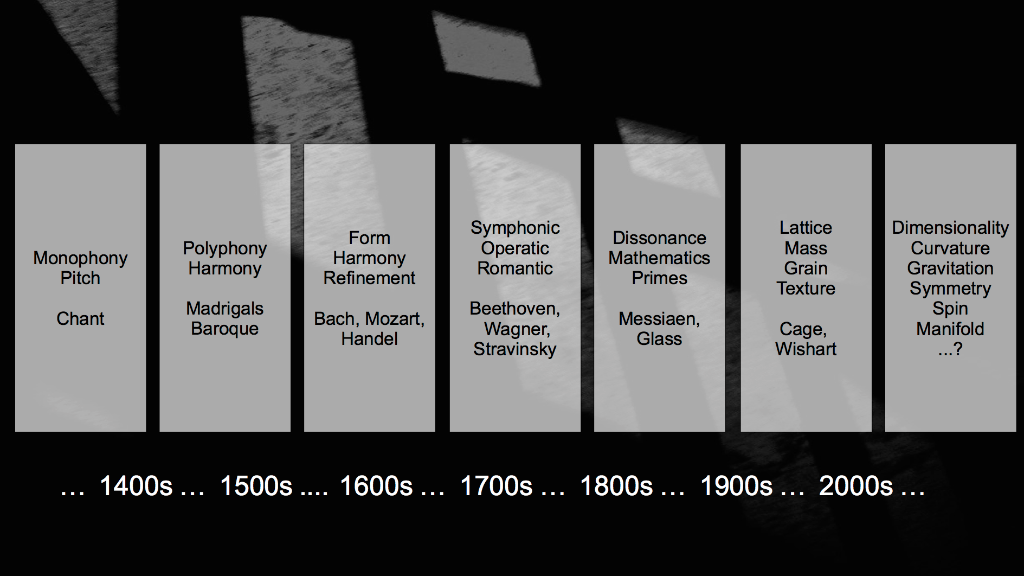
Over the last century, Dennis Gabor (1947) proposed that sound could have an acoustical quantum, an irreducible cell in the time-frequency plane governed by an uncertainty relation, with Gaussian elementary signals as its atoms/grains. Claude Shannon (1948) abstracted information from its medium, making entropy measurable across signals and Iannis Xenakis late 1950s) composed with Gabor’s quanta, building a stochastic practice that became granular synthesis, and was later codified in Curtis Roads’ Microsound. The spectralists (Grisey, Murail) derived harmony from the physics of timbre itself.
It’s worth noting that we didn’t come to Gabor’s original work until we were some way into the work, although obviously Xenakis and Roads granular work were key influences early on.
However, most works tend map physics onto sound. With Acoustic Cosmology we’re also exploring how to run this the other way around: to constructs a physics from sound, with the sonon as a first principle rather than a metaphor. The parallel evolution of musical language, from monophony through tonality and the romantic orchestra to minimalism and the synthesised grain, is part of the same story: each era’s music presses on the limits of its era’s description of the universe and we wonder what the next questions should be…
Some directions of travel
Research is ongoing, often [cosmologically] slow, and we are adding work, examples, presentation to this site as we go.
- Music of the hypersphere. If the universe may be finite and curved, what is the music of a curved, finite sound-space? Exploring the topologies of the soniverse, from the 3-sphere to Poincare dodecahedral space to hypersphere, as a compositional structure.
- The shape of musical language. Mapping the evolution from monophonic to romantic to minimalist against the physics each era describes, and exploring what the language after minimalism looks like when the composer can write the laws of the universe the music itself inhabits.
- A language for grains in visual interpretation. No equivalent of Roads’ Microsound exists for images: exploring the atomic unit (Malevich, Kandinsky, Gabor), scale hierarchy (Mandelbrot) and algorithmic practice (Whitney, Reas).
- Describing sound as material. Following the “data as art material” taxonomy work, publishing the soniverse’s own descriptive vocabulary so works of acoustic cosmology can be documented, compared and archived.
- Morphology meets cosmology. A three-way reading of Gabor’s quantum, Trevor Wishart’s sound morphologies and the sonon.
Citations & references (partial)
- Gabor, D. (1946). Theory of Communication. Journal of the IEE, 93(III), 429-457.
- Gabor, D. (1947). Acoustical Quanta and the Theory of Hearing. Nature, 159, 591-594. https://www.nature.com/articles/159591a0
- Shannon, C. E. (1948). A Mathematical Theory of Communication. Bell System Technical Journal, 27, 379-423 and 623-656.
- Gödel, K. (1949). An Example of a New Type of Cosmological Solutions of Einstein’s Field Equations of Gravitation. Reviews of Modern Physics, 21(3), 447-450.
- Penrose, R. (1989). The Emperor’s New Mind
- Xenakis, I. (1992, revised edition). Formalized Music: Thought and Mathematics in Composition. Pendragon Press. (Includes the stochastic grain theory first published in the 1960s.)
- Wishart, T. (1996). On Sonic Art (revised edition, ed. Simon Emmerson). Routledge.
- Clark, A. & Chalmers, D. (1998). The Extended Mind. Analysis, 58(1), 7-19.
- Kramer, G. et al. (1999). Sonification Report: Status of the Field and Research Agenda. International Community for Auditory Display.
- Roads, C. (2001). Microsound. MIT Press. [PDF]
- Plotnitsky, A. (2002). The Knowable and the Unknowable: Modern Science, Nonclassical Thought, and the “Two Cultures”. University of Michigan Press.
- Barad, K. (2007). Meeting the Universe Halfway: Quantum Physics and the Entanglement of Matter and Meaning. Duke University Press.
- Hermann, T., Hunt, A. & Neuhoff, J. G., eds. (2011). The Sonification Handbook. Logos Verlag.
- Voegelin, S. (2010). Listening to Noise and Silence: Towards a Philosophy of Sound Art. Continuum.
- Díaz-Merced, W. L. (2013). Sound for the Exploration of Space Physics Data. PhD thesis, University of Glasgow.
- Kane, B. (2014). Sound Unseen: Acousmatic Sound in Theory and Practice. Oxford University Press.
- Luminet, J.-P. (2008). The Wraparound Universe. A K Peters. and https://arxiv.org/abs/astro-ph/0310253 and https://hal.science/hal-01291848/document
- Busemeyer, J. R., & Bruza, P. D. (2012). Quantum Models of Cognition and Decision
- Baroin, G. (2011). The Planet-4D Model: An Original Hypersymmetric Music Space Based on Graph Theory. In Proceedings of the International Conference on Mathematics and Computation in Music (MCM 2011). Springer.
- Starks, G. & Newsam, A. (2017). Adventures in Acoustic Cosmology. Royal Astronomical Society press release RAS PR 17/30, National Astronomy Meeting, University of Hull.
- Freeman, J., Wiggins, G., Starks, G. & Sandler, M. (2018). A Concise Taxonomy for Describing Data as an Art Material. Leonardo, 51(1), 75-79.
- Rocchesso, D. & Mannone, M. (2020). A Quantum Vocal Theory of Sound. Quantum Information Processing, 19(292).
- Paulo V. Itabora, P., Miranda, E. (2022), Quantum Representations of Sound: from mechanical waves to quantum circuits, arxiv
Other media/articles
https://honorharger.wordpress.com/2025/06/08/towards-a-cognitive-astronomy/