A few days ago I sat in a roomful of people at ‘HOLOLIFE Summit’, an event at the Sugar Factory just outside Amsterdam, where the some of the world’s longevity community gathered to talk about extending human life, biohacking and ways of being. It was quite an unusual event for me to be at, although I always enjoy leaning into unexpected communities, encouraging serendipity and building bridges between disciplines.
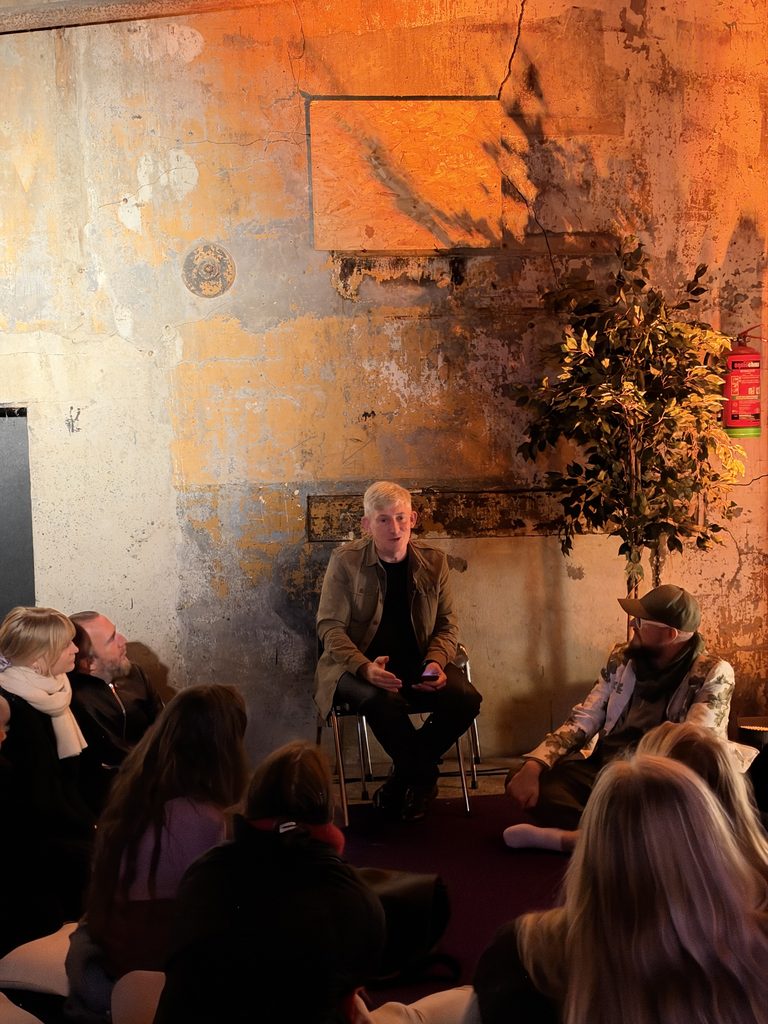
With thanks to Carl Hayden and the Museum of Consciousness (MOC), both Tom Middleton and I were invited to present REDSHIFT: in a more immersive environment, including a general panel about MOC, and a one hour discussion anchored on REDSHIFT: itself.
The heating was on (it was very cold in the building); people were drifting in from other stages; and we gathered for a conversation.
[photo: Krystel Juvet]
I began with two questions, linked to the theme of the event:
How long do you want to live?
What do you want to last?
These two questions live in different spaces: one about the self, the other is about everything that comes after the self. The gaps between them seemed, to me, less well explored and where some of the interesting conversations of our time are hiding. I’ve written up some of it here.
Thinking in scale
Imagine a kilometre
You can hold it in your head: a walk, a bridge, a stretch of road. Now if you try to imagine three hundred thousand kilometres, your brain likely refuses. This is the distance light travels in a single second (the moon is just over one light-second away).
The Voyager 1 spacecraft, launched fifty years ago, is the most distant human-made object that has ever existed. By coincidence this week it also crossed a quiet but profound threshold: it became one light-day away from Earth: fifty ‘human years’ to cover what light crosses in twenty-four hours. We can send it a signal, it takes a day to arrive, and a day for the reply to come back.
We are already a species capable of making things which outlive us by orders of magnitude: the pyramids still stand after thousands of years with their hieroglyphic and other messages so lost in time, we had to re-learn how to read them. They were, presumably, written by people who were confident that their messages would remain obvious forever.
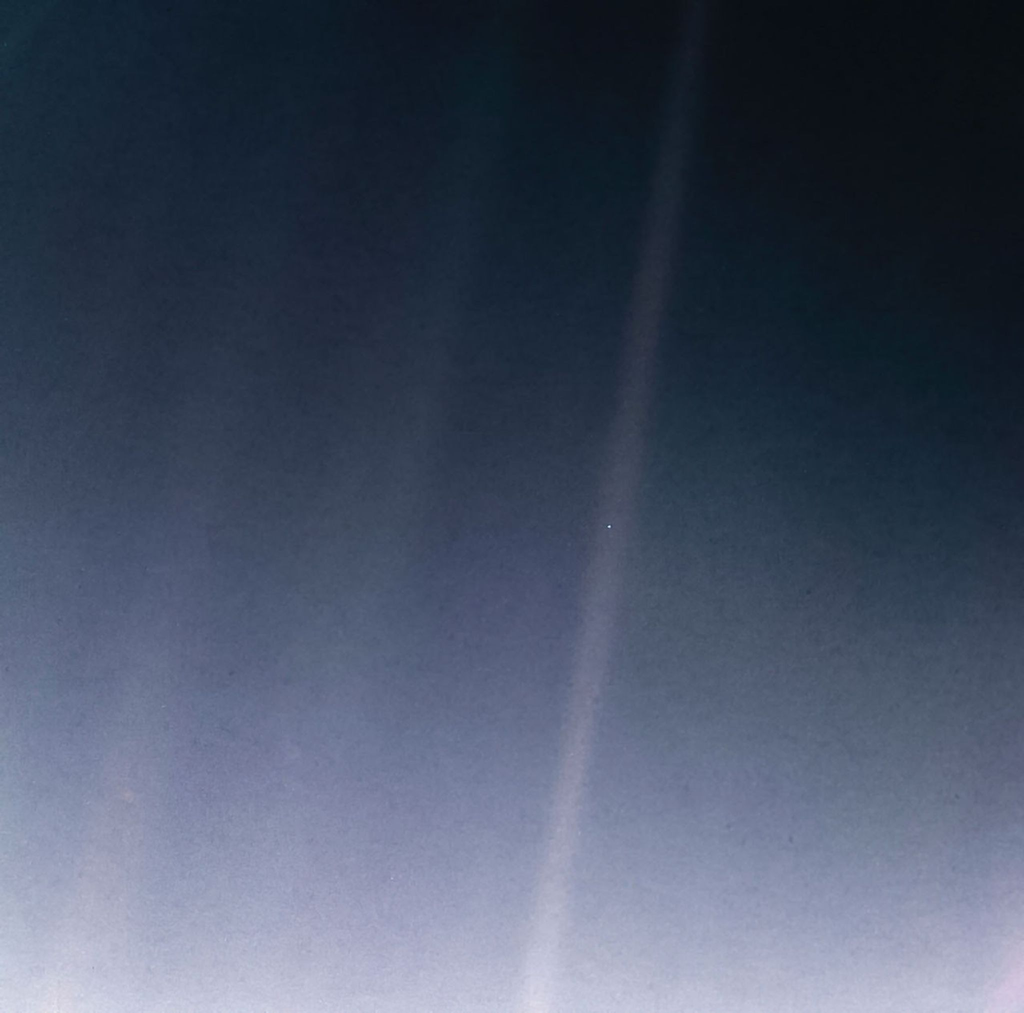
The Pale Blue Dot, taken by Voyager 1 as it looked back at Earth from beyond Saturn, reduced our entire civilisation to a single pixel of reflected sunlight. We are, simultaneously, both wildly insignificant and wildly significant As far as we can tell we are the only place where the universe that has learned to look back at itself.
[photo: Voyager 1]
So when we ask how long we want to live, my instinct is to ask a smaller, more incisive question first: why?
Are we living in an age of temporal poverty?
A paradox of the longevity movement is that it feels like we have never wanted more time with such urgency and, simultaneously, we have never felt so hurried.
Do we live in an age of temporal poverty? Our attention is grabbed in micro-increments by devices designed to enthral us – constantly pushing us to languish in the shallows of time, unable to inhabit the a deeper time, within the period of time we have already been gifted.
Carl spoke earlier in the day on the transition from altered states to enduring traits, and on ‘epiphany porn’ where momentary or transitory experiences outpace meaning.
In our session we talked about the different kinds of death: physical death, brain death, and then the third, quieter one – the last time someone speaks your name. We discussed how this third death terrifies our ego, and why some individuals make such enormous noise to be perceived to be heard above the noise (e.g. certain members of the billionaire class who would rather believe the ‘rest of us’ are non-playing characters, than confront their own insignificance, while building ways to escape Earth itself, rather than repair themselves, and it.
[photo: Gavin Starks]
Against that noise, the summit’s theme Life Beyond a Lifetime took on a different direction: if we extend individual life without repairing our relationships with time, do we simply stretch out the pace that exhausted us in the first place, with more years at a furious tempo avoiding healthy longevity and revealing just a longer sentence. What is the point of living longer if we don’t also expand what we care about and act upon this knowledge? Are you trying to live longer, or are you a custodian that helps things last longer?
Belonging across time
This question connects to another body of work that I am part of: as a trustee of Longplayer (https://longplayer.org, created by Jem Finer). This started as piece of music designed to play for a thousand years without repeating. It began playing at midnight on the 31st of December 1999, in the last remaining lighthouse in London. It will continue to play, in some form, somehow, without repetition until the last moment of 2999, at which point it will complete its cycle and begin again.
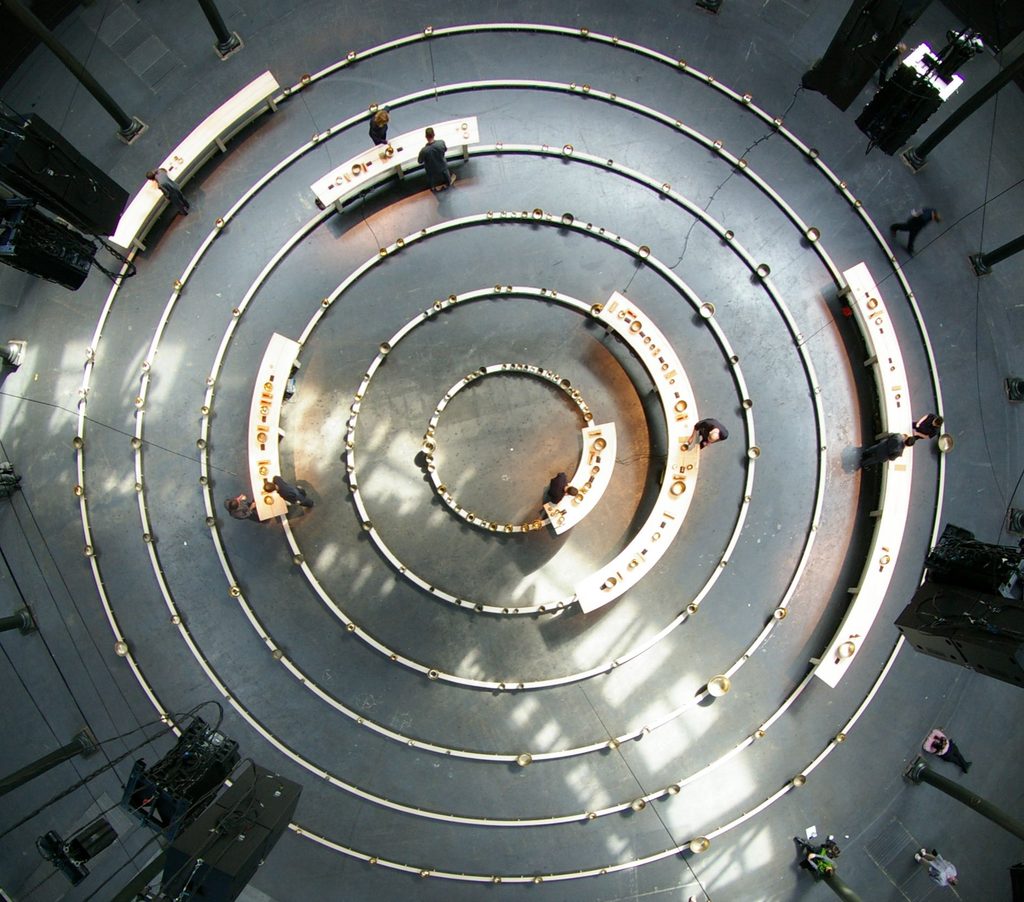
Longplayer is something no single human being will ever be able to experience in full. Its survival is not dependent on a single technology (e.g. the web has existed for a millisecond of human history) and we have spent years debating how to encode it in a form that can survive (and will want to be survived) for dozens of generations. Whether in scores, song, nursery rhymes, DNA, or a satellite, it will depend on strangers unknown caring for a future that they will never see: a relay of custodians across generations who we will never meet.
[photo: Longplayer.org]
In a series of essays I wrote on the theme of How Will We Be Long?, I came back again and again to the same principles of belonging across time. While we are used to belonging to a place or a tribe, Longplayer asks us to belong to a duration. It asks the same question the pyramids ask, but without kings, what are we willing to steward, together, on timescales that make our individual lifetimes look like a pixel?
Hearing time across our universe
Which brings me to cosmology, and to an island.
I grew up on the Isle of Arran, off the west coast of Scotland, in a village of about six hundred people. There were no street lights and, when it wasn’t raining, you could look up and see the Milky Way: I went on to study Astrophysics. My grandfather lived with us and passed at one hundred and seven years old: born in 1901, in his single lifetime he bore witnessed the fundamental discoveries of our place in the universe: relativity, quantum mechanics, the big bang that radically reshaped our perspectives on time.
[photo: Gavin Starks]
A university classmate of mine went on to build part of the gravitational wave detector which, twenty-five years later, when switched on immediately caught two black holes colliding: an event so violent that the space the Earth sits in wobbled by a fraction of a picometer (0.013 picometers=roughly the width of an atomic nucleus).Almost everything we understand about the universe arrives through light, photons travelling across space without, unlike sound, needing a medium. (e.g. this is why a bell ringing in a vacuum cannot be heard but it can still be seen).
Through my understanding of both astrophysics and electronic music, I have been exploring what might happen if we tried to hear the universe instead? Not as an literal listening to the sky, but as a way of bridging and navigating our perceptions of structure.
For some decades years now, we have been building what we’ve called a soniverse, a sonic universe constructed from first principles using the same mathematical principles that describe our universe (and other potential universes). In it, instead of the photon, its fundamental unit is the sonon: a single grain of wavelength. We then try and explore how the curvature of a spacetime might sound.
When we explore in this way, we start holding many types of clock at once: from the oldest light in the universe (the cosmic microwave background, or CMBR) which was formed 380,000 years after the big bang (itself 13.8 billion years ago) to a single grain of sound to the Plank time (10⁻⁴⁴ seconds = that’s 0.[44 zeros] of a a second). Somewhere inbetween these unimaginable scales lies the duration of a piece of music, the lifetime of a human, the one-thousand-year arc of Longplayer, and the hour we spent in this room today with other people.
REDSHIFT: a point in a journey
Can we begin to hear that time has a topology? (note: a topology is a type of geometry where certain properties and spatial relationships do not change when it is stretched, bent, or twisted. We use this term when talking about cosmologies, instead of geometry, as we need more ways to describe space and time).
REDSHIFT: is a collaboration with Tom Middleton (whose practice designs immediate sensory environments, sound and light and space, to shape how our human nervous system functions). We took our joint perspectives and smashed them together at cosmological scales, to create a twenty-minute piece of acoustic cosmology. It was created for a performance at the Amsterdam ARTIS planetarium, and performed again at HOLOLIFE as a sound-only version.
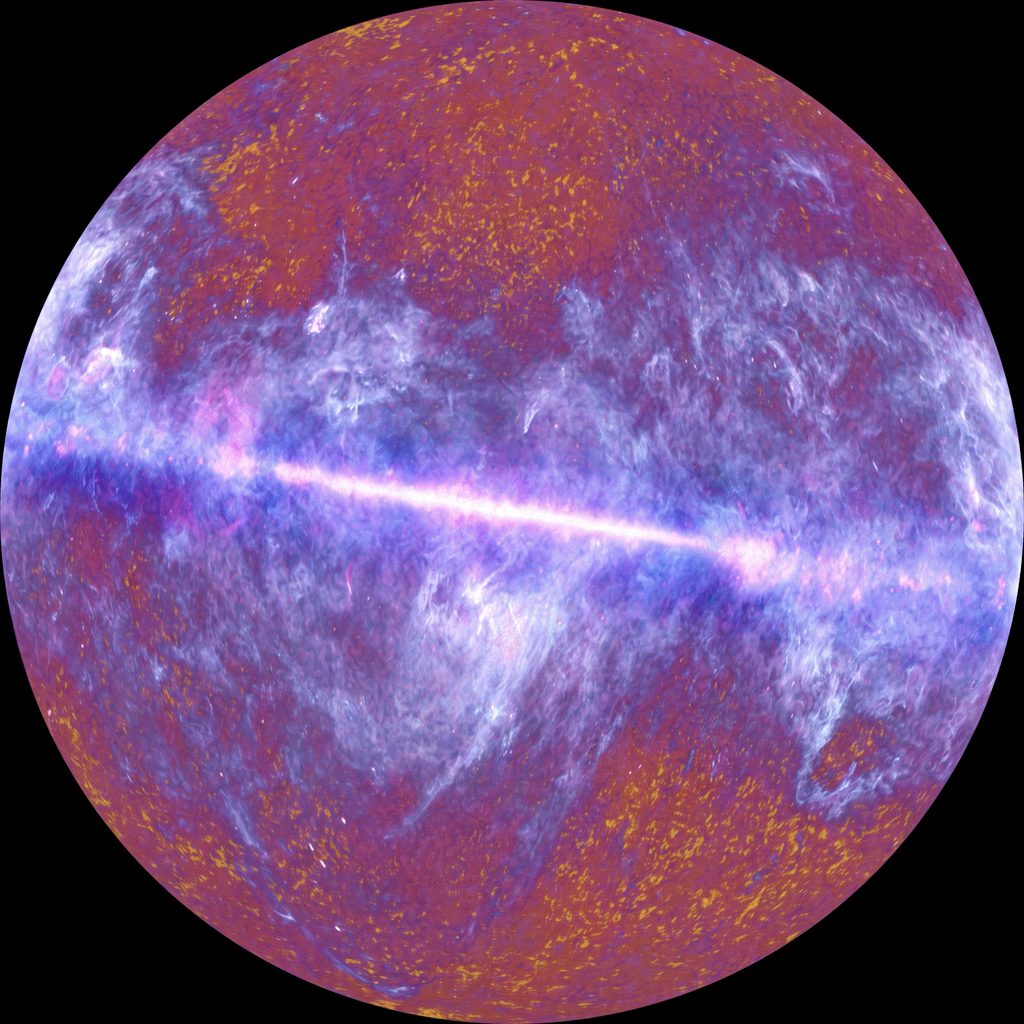
The piece is a journey that starts where its audience is, in noise: the ambient static of modern life, the hyper-vigilant nervous system each of us walked into the room with. From there through CMBR formation to long descent: a gravitational redshift.
[image from REDSHIFT:]
In physics, redshift is similar to what happens when an ambulance passes you: its siren is high-pitch on its way towards you (as the sound waves are compressed) , and lower pitch as it recedes away from you (as they are stretched to lower frequencies). This also happens when the universe expands: as galaxies move away from us (in every direction) their light is stretched and reddens. In our piece, the descent in pitch pulls us down through timescales that far exceed human experience.
At the end of this descent is a moment of silence: pre-bang, pre-sound, pre-time, an origin of unknown depth and without duration.
We tend to treat silences as an absence or nothing, but in our hurried culture, we strive for it: silence is one of the most radical technologies we have. It is a moment where our nervous system stops having to perform and starts simply being ‘located’.
I’m sure the summit’s breathwork and sound practitioners know this territory intimately, REDSHIFT: simply arrives at the same stillness through a cosmological-time lens.
When the blueshift (in moving back towards us) begins: the pitch climbs but not to where you started; you return into a changed space; a recalibrated perceptual field; finally home to Earth, into this room, into this body, next to these other people.
Whether music, or a guided meditation, a series of questions, or the start of a conversation, REDSHIFT: creates a space.
Temporal restoration
And this is the theme upon which we conversed: a temporal restoration.
Can we restore our relationship with time, not through chasing efficiency, time management, productivity, or turning wellness and mindfulness into an industry instead of being in time as a practice?
Can we restore of our felt connection to deep time, through a deliberate recalibration of our perceived urgency, fighting against the pacing of the universe? When we expose our nervous systems to measurements in seconds to a cosmology measured in billions of years, can we ask structural questions: does our subjective sense of duration expand, can it help settle parasympathetic systems, and release our frenetic grip on the next twenty minutes?
[Photo: Gavin Starks]
Tom spoke to the two environments we inhabit: the first, immediate – the light, the sound, the spaces that act on us today; the second, generational- the planetary conditions that make human flourishing possible for centuries.
We can design for both and, while they run on radically different clocks, perhaps the challenge is how we learn to inhabit both at once. If a culture is only capable of designing for the first clock, is it a culture that will consumes its own future?
For the Museum of Consciousness, which Carl founded to explore these transitions, a core question is how temporary altered states might becomes an enduring trait.
An acoustic cosmology could be valuable if it leaves a somatic memory of deep time which you can return to long after the headphones come off, or the speakers still: can it be a physical reminder that there are clocks much slower, and much larger, than the one on your wrist?
As we return
Toward the end of the session, after travelling with Voyager, through black holes and lighthouses, we brought our two questions back into the room.
How long do you want to live?
What do you want to last?
If there was a quiet centring to what we discussed today, it was that the second question is the one that makes the first worth answering.
We might wonder if it is just assumed, a given, or an internal feeling, or something others’ don’t ask, or don’t vocalise, or not important, or simply just a lonely idea, left unspoken.
Longevity cannot be about the private ‘hoarding’ of years: it must deepen the why, the of what, and of whom do we belong to across time. It is our recognition, in those moments of silence, that while our time is short, and therefore precious, it is only survived by belonging.
REDSHIFT: itself represents an utterance of a cosmology; does it help us ask better questions?
Our lives are finite, our responsibilities are not.