Overview
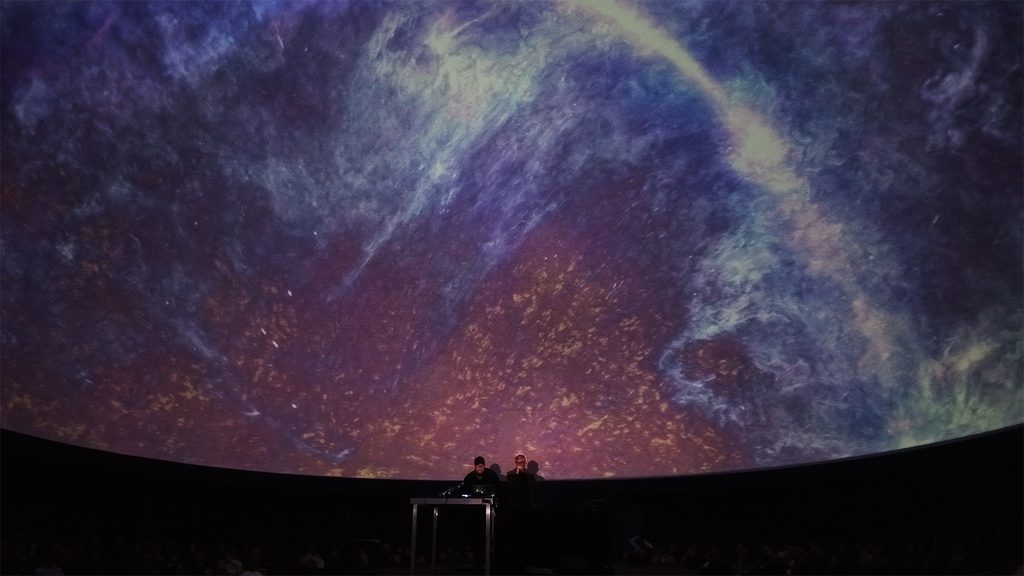
On Sunday 25 October, Tom Middleton and I presented REDSHIFT: Slow Down and Reconnect with Time at ARTIS Planetarium in Amsterdam.
It was made, as a 20-minute instance of an acoustic cosmology, for a room with no front: seats forming concentric rings beneath a 20m diameter dome.
It’s worth saying that twenty metres is huge: seeing the visuals at that engulfing scale, with a substantial sound system which shook the room, was really quite something. There are lots of scientific, mathematical and technical details, which I’ll cover in separate posts: this post is about its theme and narrative.
The piece is anchored around a period of time which takes us away from being engulfed by our surroundings and the noise of our contemporary worlds, into a moment of complete silence, stillness and blackness.
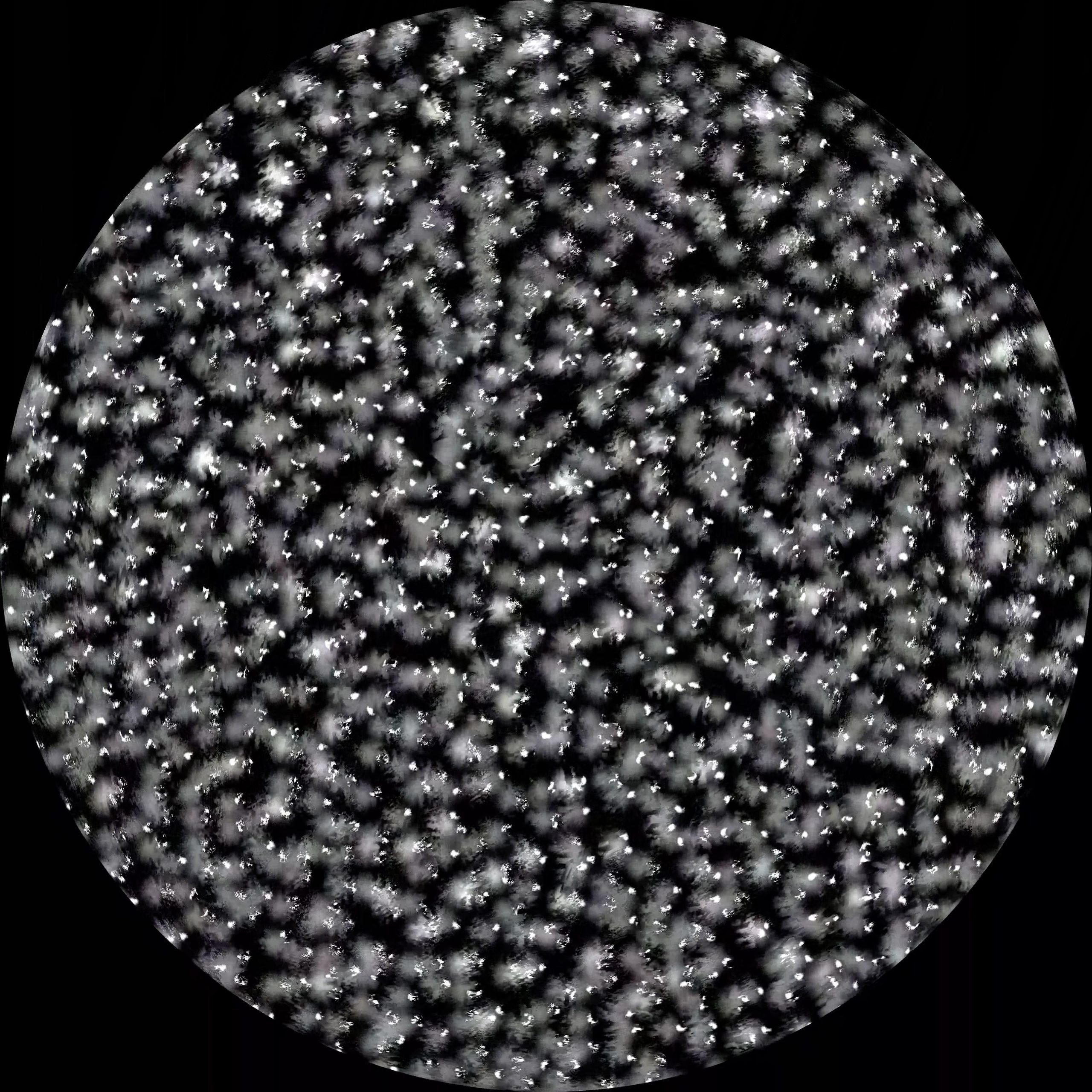
It begins with noise: a chaotic genesis that is both celebratory and complex. Initially, a single pixel fills our entire perspective, and evolves into quantum fluctuations from which a universe might emerge.
Before asking us to slow down, we must reflect on something to slow down from. The noise of the opening is a carrier for the internal noise that everyone has arrived with.
Background
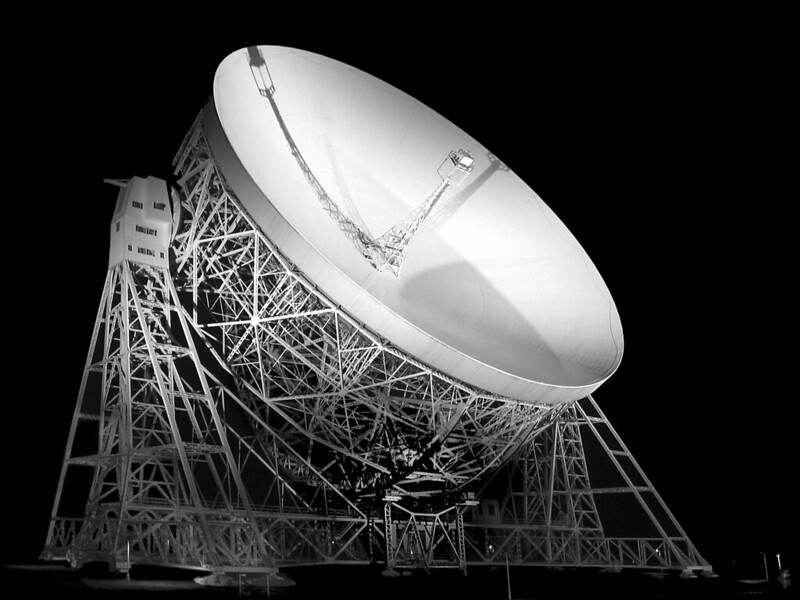
From 1993-1995, moving between astrophysics and computer music, and then working at Jodrell Bank, I started creating highly textural music that blended modelling, time-stretching and Western classical narratives.
A question emerged through this: is there a musical equivalent to the curvature of spacetime?
For me music, like mathematics, is a non-verbal language through which I can describe a set of relationships without having found words to express them. Acoustic cosmology is a way of exploring that gap: could we make a sonic universe with its own basic units, its own laws, and ways of changing the relationships between sounds? I defined its proposed basic unit a sonon: one wavelength—a model for making and thinking about music.
We have developed ways that let us hear galactic observational spectra, or listen to the mathematics of expanding universes, or spread gravitational wells across the frequency spectrum of a sound and let sonons fall into them. Some masses sound when a grain reaches them, others remain silent but still impact the paths and pitches of other grains around them. A dense wall of grains can be bent or partly absorbed, changing their texture and leaving gaps. This soniverse instrument lets us place black holes onto the frequency spectrum of a stream of sonic particles.
For REDSHIFT:, these tools form an ensemble of instruments in its compositional material.
The development of REDSHIFT: began with its narrative structure, using existing and new sonic instruments, composing some of the music for Tom to build upon, and creating all of the visuals.
Tom fed into the narrative development, added his own compositions and orchestrations, mixed and processed the sound live on stage. As our first collaboration, it was a wonderfully symbiotic and constructive feedback loop.
It’s worth mentioning (especially as it was raised in the audience Q&A) that I used ‘ai’ to create of some of the tools not content, which I then used to create the piece, as a way of helping develop a palette—but not in the creation of the actual piece or its narratives. There are many issues with ‘ai’, some of which the audience asked about during the panel, but I have little issue in getting it to write software that I can then use to try and express what’s in my head, or to create editing tools. I’ve been using, writing, and helping to build software that enables creative interpretation for over four decades, and see ai as a new toolbox. This is not to avoid the fact that ai/machine-learning is being used in negative ways, but that’s not for today.
Superpositions
The opening quantum fluctuations could have gone in many directions, but here they condense into a blend of the cosmic microwave background radiation (CMBR) with an image of our galactic plane. Both these images were captured using the ESA Planck spacecraft and represent very, very different scales: one is the ‘heat remnant’ imprint from the big bang and early universe, the other is the plane of the galaxy in which we live. The CMBR is the oldest light in the universe—a trace of the universe’s ‘becoming’ rather than an instant of creation.
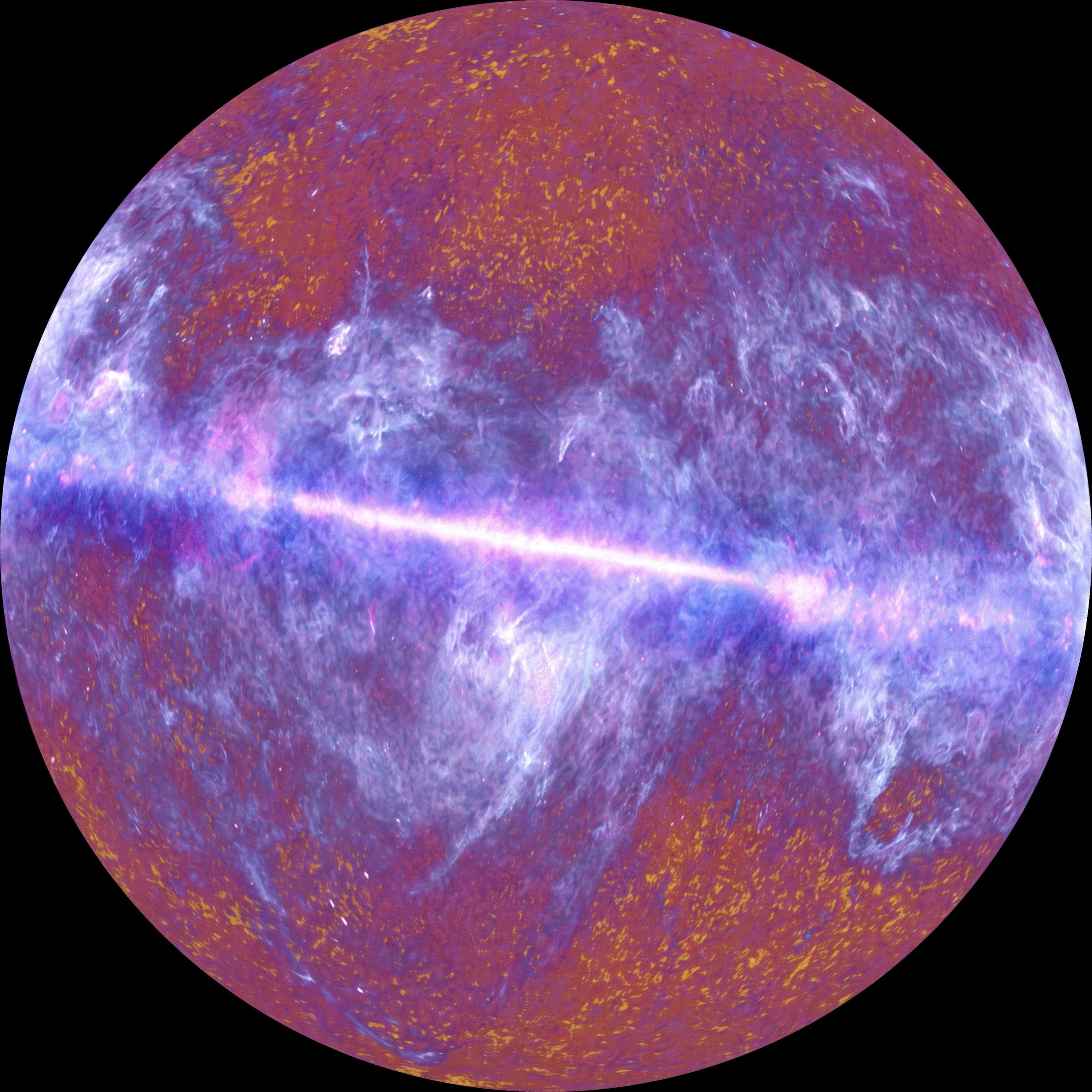
As this image forms, our introduction narrative begins:
We are made… of time.
What noise have you brought into this room?
Noise that you carry from outside;
from within?
The question is about what arrives with us and, to disrupt our audience’s noise, we bring some heavy and challenging images in contrast to the serenity and grandeur of the space (partly inspired by my thoughts for friends in Ukraine):
Can you imagine the sound
of an unborn child, listening,waiting;
of an undropped bomb;
of an unexpressed love.In here, we explore ideas of superposition;
That which exists in multiple states before collapsing … into something real.
Whether quantum mechanics; a feeling left unspoken; an idea, lingering
Superposition embodies the idea that many things are held in possibility, with very different meanings and wildly different emotional and practical consequences. I wanted to bring our more familiar experiences of the unexpressed into contact with the much stranger language of superposition, quantum mechanics, and our perceptions of time.
nothing is real … until it is uttered … or observed.
In the beginning there was nothing. And then there was noise.
The utterance of a cosmology.
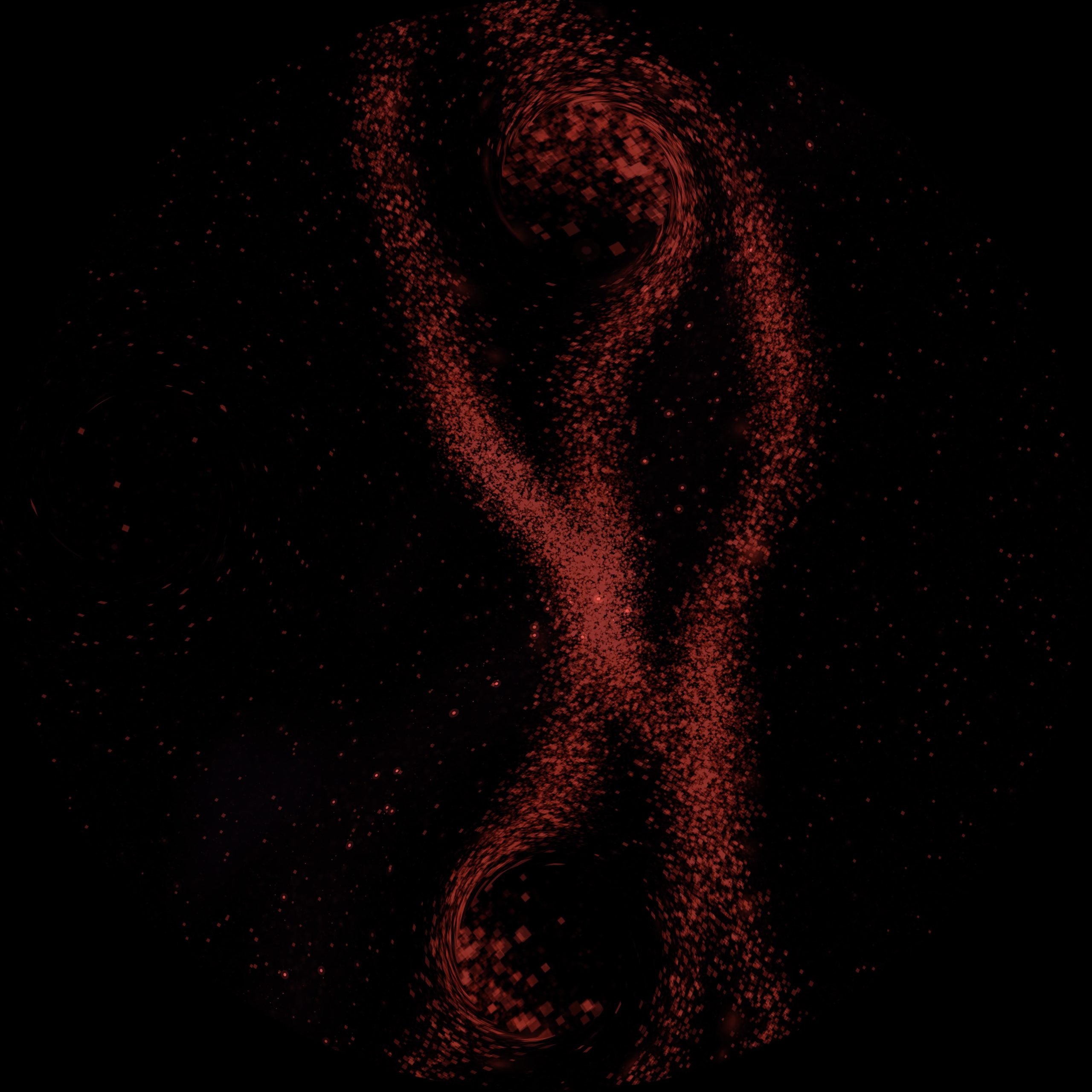
Our visuals develop into a large-scale galactic-scale structures with gravitational wells (e.g. black holes) distorting the field and visual echoes of wormholes. Some of the gravitational lensing adds pixellation; quantisation artefacts that reflect and question our perceptions of spatial and temporal resolution. These are challenging ideas. Our sounds follow a downward spiral, a continuous slide in frequency, with Soniverse artefacts contributing to a redshifted departure: a distance measured in tone, colour and pitch.
Before the Big Bang, there was no space, no time, no sound.
We were even… pre-silence.
Before there was a topology, there could be no sound.
Even silence had no meaning.Our time, our space, are shaped by our mass, creating gravity that pulls us…
Let us step back.
In astronomy, redshift occurs when objects are moving away from us, stretching wavelengths and lowering frequencies (as a siren does when an ambulance is travelling away from us).
The visual tools I developed gave me ways to work with fields, data and parameters rather than ‘literal’ objects: enabling the shaping of particulate densities, filaments, clusters, gravitational intensity and moving the image through different gravitational wells. This was a very involved feedback loop; to discover which relationships could become effective in the piece rather than simply ‘lots of different controls’.
The structure moves through redshift towards blackness, rotating anticlockwise (both an unwinding, and the orientation of Earth’s spin looking down from the north pole). It is an decompression into silence; descending sound and fading image leads us into the silence of the work.
Descent into pre-time
In the middle of REDSHIFT: there is a period of complete audio silence and total blackness.
On one level, it is a very ordinary moment: a moment of quiet, where we spend time waiting for things, checking things, passing between things.
Here it is a moment to stop, after the complexity of the genesis and audio-visual descent, we are left with no markers. I announce to the audience to expect such a moment, so they do not think the piece has finished, but I do not reveal its duration, deliberately: this is a provocation, an empty unknown.
I’m interested in what happens to our relationship with time when the material that has been focusing and organising our attention is withdrawn: are we left adrift? is one’s mind left spinning? have we slowed enough to enjoy the peace within the piece? The period is there to be encountered, without knowing how long it will last: has those in the room had the same experiences as each other? Our earlier question, “What noise have you brought into this room?” remains open, unanswered.
Returning to a changed space
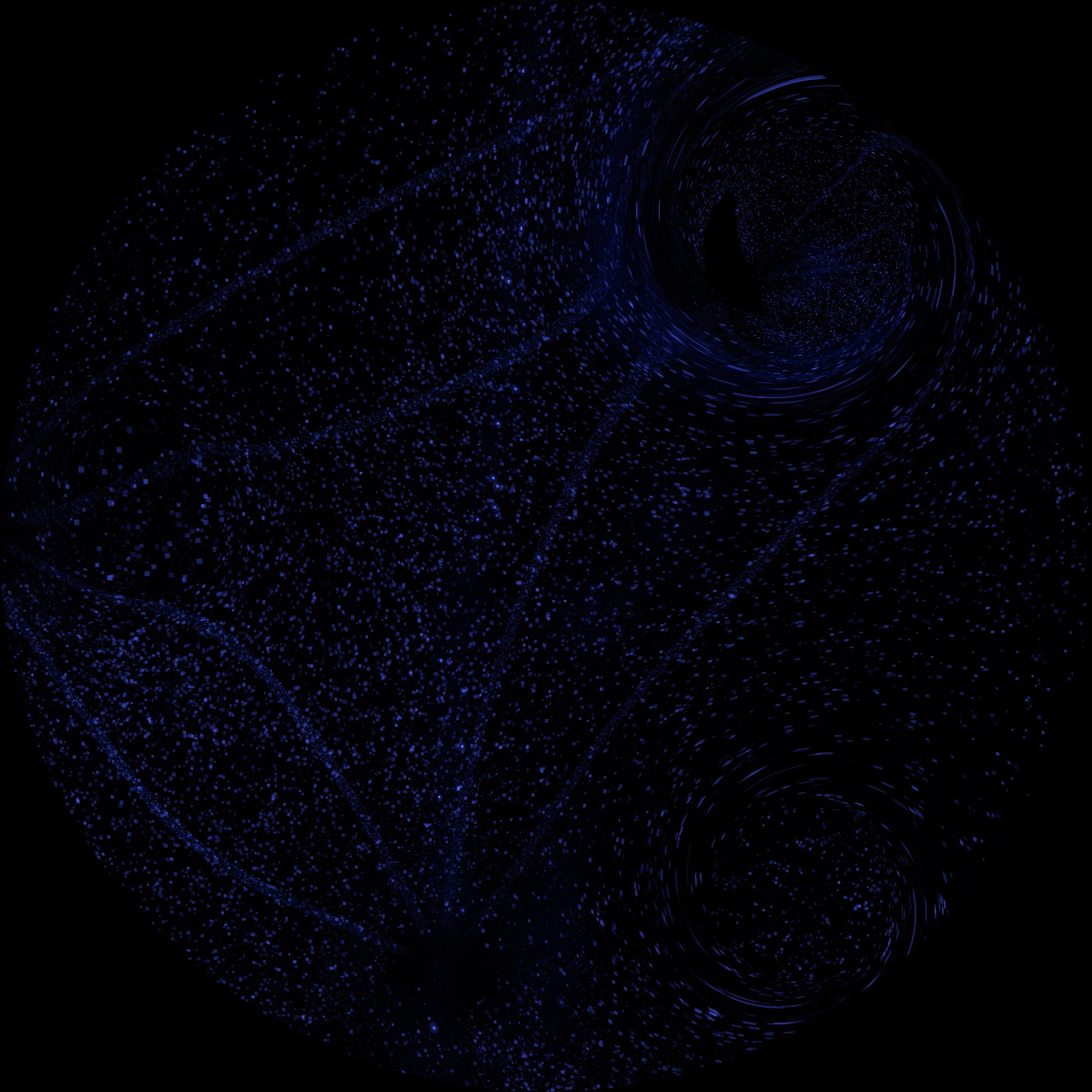
Large-scale galactic structure emerges from blackness into a faint blueshift; gravitational wells return; sounds rise in frequency, rotation is clockwise. But the macrostructure has changed: we are not running the descent backwards to return to where we were. There are new visual echoes of the Laniakea Supercluster and the Lahaina Noon Sky Gate. An organ sounds.
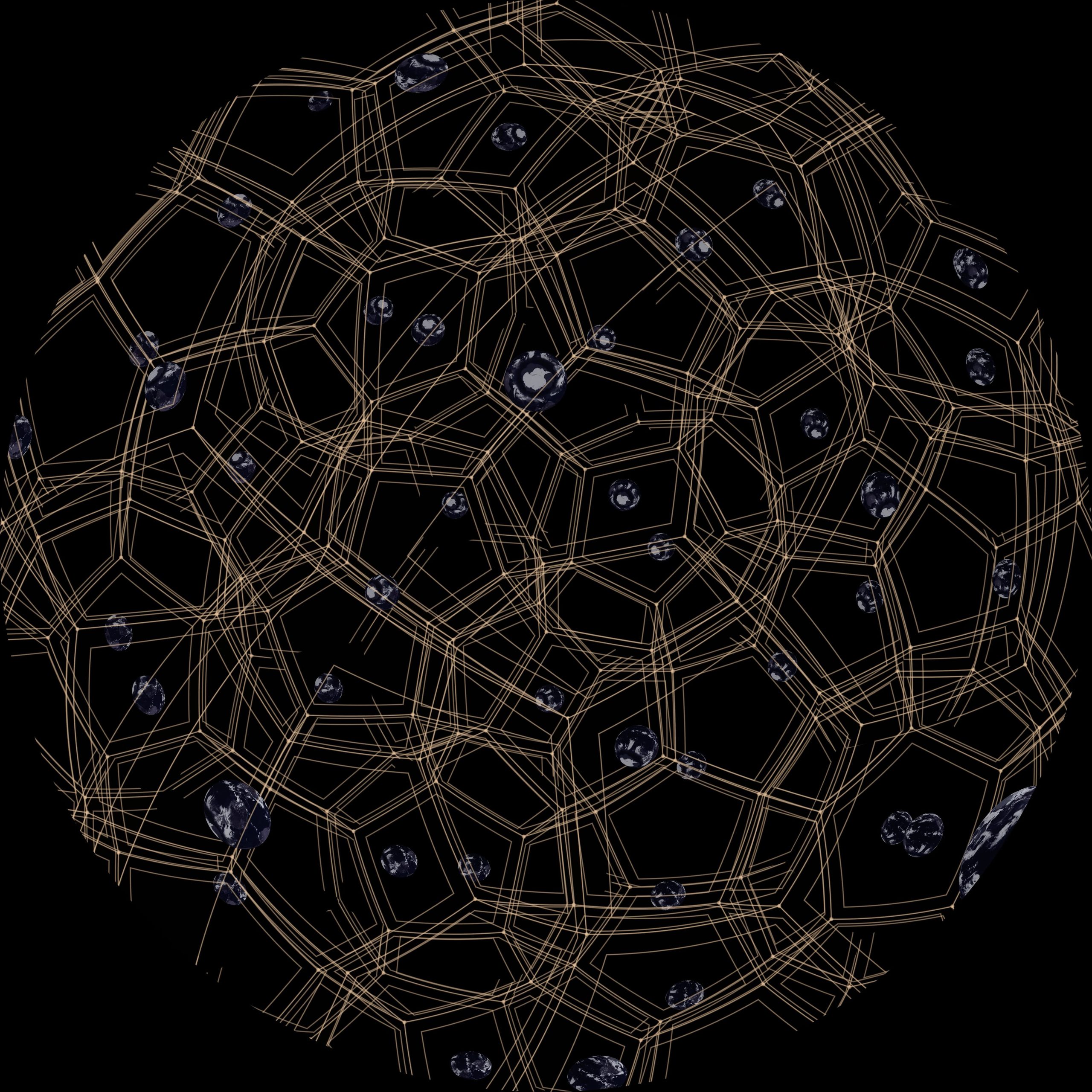
We emerge into a Poincaré dodecahedral spacetime with multiple echoes of Earth against a visible grid, with deep organ sounds and bright textures, bringing us back into a celebration of our present, our future, but with questions of our perceptions of time remaining.
I’ve been a fan of Luminet’s wraparound universe for a long time. It’s a Poincaré dodecahedral space which was proposed as a potential cosmological topology: a twelve-faced cell whose faces are joined. Looking through one face can bring another view of the same space back to you. The repeated Earths used in the piece echo the fact that our potential models of time and space are as infinite as the number of ways that different humans might interpret them.
When you understand the fundamentals of cosmology, you can’t unlearn them: our place in the universe is both insignificant, significant, and overwhelming, it’s hard to truly process, and fundamental to our comprehension of our origins.
In our return, we ask what are the shapes of time that we can explore, what is our place within them, we make the familiar object of our Earth appear within an entirely unfamiliar organisation of space. What are the infinity of ways in which can we imagine our relationship with time?
The dodecahedral grid makes that organisation visible for a while, then fades but leaving the topology: its topology is unseen yet visible through its interactions. This is an important part of the passage—a topology made visible, echoed in sound, but the relationship is less directly obvious, movement continues to give glimpses of encountering structure, but only if we are observing (listening, watching).
Becoming Earth
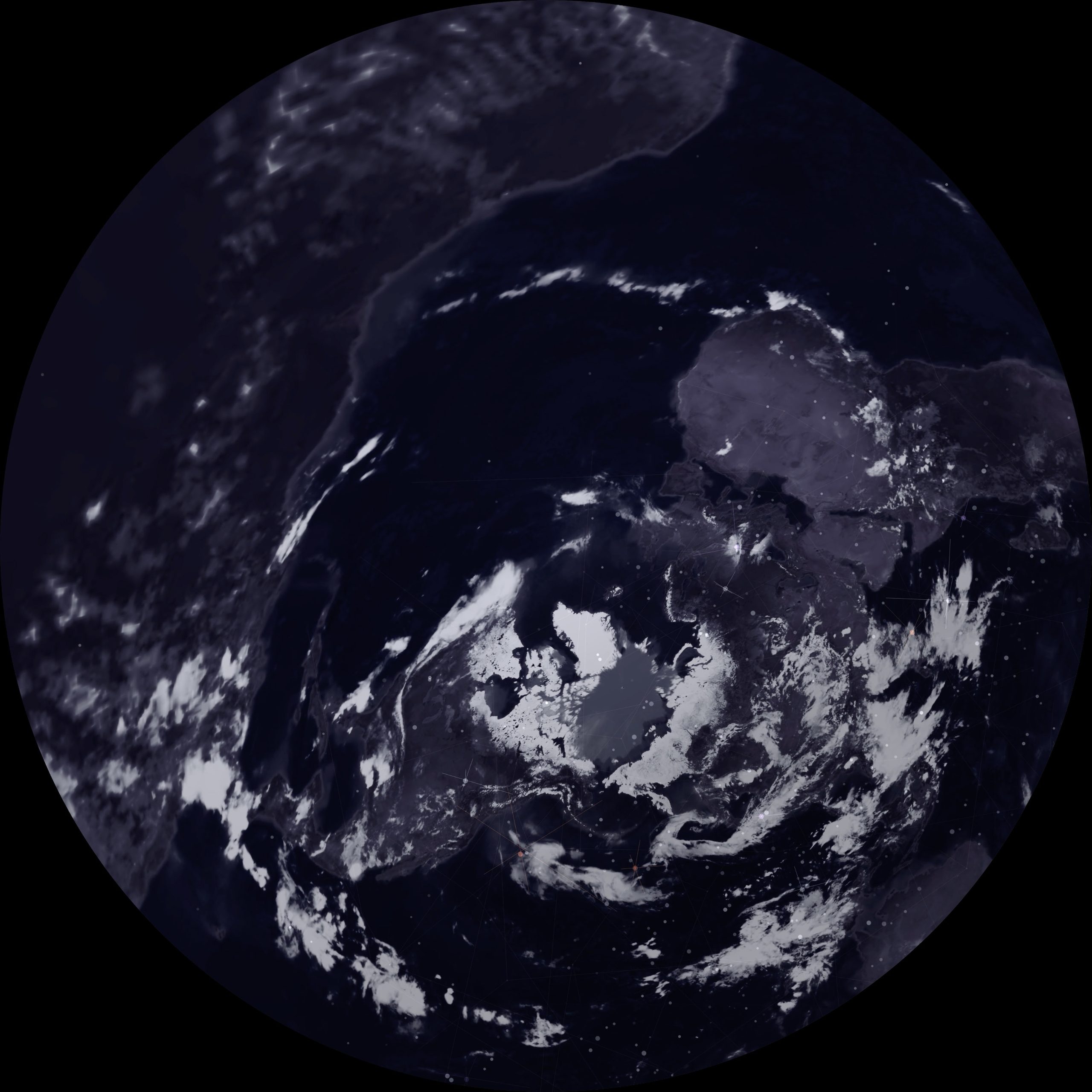
Earth emerges through our topology; satellite transmissions pulse around our ears with visual echoes of the CMBR remnant. As the view moves closer, we transition ‘inside’ Earth, transformed by the topology we have been exploring: an insider’s view of a perspective that can never be experienced in our real world.
As our Earth morphs out of the Poincaré topology into its recognisable state and recedes, its colours move from a dark blue night (ESA-sourced) image towards the familiar green and blue: we transition from night to day.
As we return from redshift … through blueshift.
Through an infinity of mirrored topologies
As we slow down,
can we take a step closer?
While the image moves away, the narration ask us to come closer—whereas in the beginning we were asked to step back, can we now find a different way of considering what is near? The place we inhabit and the people with whom we inhabit it, those next to us.
Can you see yourself as not the only thing
holding time,
seeing time,
being time?
REDSHIFT: brings many scales of time into focus in one piece, from the short duration of a sound grain to the big bang, from galactic evolution to topological disruption, from the twenty minutes of the piece to the deep time embodied in the CMBR, to the human time of being in a room beside other people, waiting for the next moment.
In the script I attempt to hold these scales together without explaining away the music or visuals. In opening, I asked what we have brought with us, in closing I ask how you have felt time, and whether looking beyond our own time might bring us closer into our shared present; to be present.
‘Temporal restoration’ is an invitation to think differently about time, to step back, to listen, to pause, to attend differently to pace, space, duration, noise, signals, and to those who sit next to us.
Our time
Deep time
A step towards
A temporal restoration
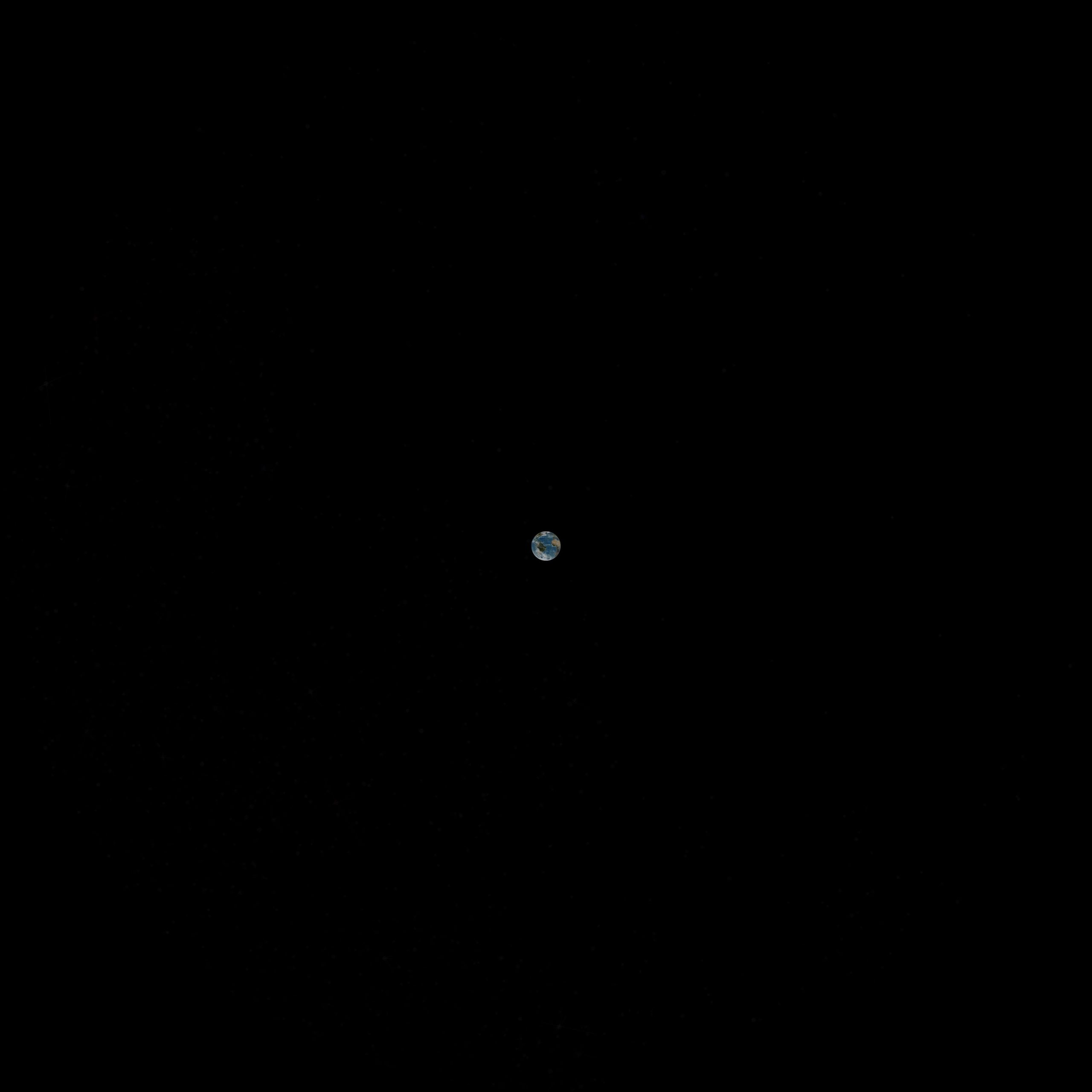
Finally our Earth recedes towards a Pale Blue Dot (a nod to this truly spectacularly humbling image).
Credits
We presented Redshift and participated in the panel discussion with the support of the Museum of Consciousness as part of Signals: Hearing a Changing Planet, presented by EarthSonic, ARTIS (https://www.artis.nl/en/artis-zoo/daily-schedule/signals-hearing-a-changing-planet) and ADE Arts & Culture with support from the European Space Agency.
My thanks to Tom for the music and collaboration, to Andy for the questions and demonstrations that have accompanied this work for so long, and to EarthSonic, ARTIS, ADE, ESA and the Museum of Consciousness for inviting us into this setting.